Trump wasn’t kidding
Gaza Peace Deal is Really about a PIECE Deal: A closer look at the players positioned to get a piece of the action

We’re ALL glad about the end of destruction and killing in Gaza and release of prisoners, but the reason for signing the peace deal was NOT motivated by empathy as we might be led to believe. Trump is taking credit for the peace accord as a humanitarian effort, but as with everything else Trump is involved with, it’s all about the money.
As of October 13, 2025, the U.S.-led peace plan to end the war in Gaza was formally signed by the United States, Egypt, Qatar, and Turkey, which acted as mediators
. This agreement was signed during a summit in Sharm el-Sheikh, Egypt, on October 13, 2025, and followed a ceasefire between the direct parties, Israel and Hamas, who did not attend the signing ceremony.
Who signed the peace plan
The countries that formally signed the “Sharm El-Sheikh Agreement (Peace Declaration)” as guarantors of the plan include:
United States: Represented by President Donald Trump.
Egypt: Represented by President Abdel Fattah el-Sisi. Donald Trump was famously overheard calling el-Sisi “my favorite dictator” in 2019.
· Sisi has replaced the extensive social welfare and redistributive polices of the post-1952 republic with an ethos of “nothing for free,” while marginalizing the public sector, which previously formed the primary sociopolitical constituency of the regime;
· The president has awarded himself “hyperpresidential” powers exceeding those of all his predecessors;
· The political primacy of the armed forces is both set in stone and fundamental to the evolution of the Second Republic;
Qatar: Represented by Emir Tamim bin Hamad Al Thani. He holds ultimate executive, legislative, and judicial power in Qatar.
· The personal net worth of the Emir of Qatar, Sheikh Tamim bin Hamad Al Thani, is estimated to be around $2 billion. However, his family’s total wealth is much higher, estimated at approximately $335 billion. This vast fortune is a result of Qatar’s natural resources and the family’s significant global investments in real estate, companies, and assets like luxury yachts and airlines.
Turkey: Represented by President Recep Tayyip Erdoğan.
· Organizations like Freedom House now rank Turkey as “Not Free” due to the significant consolidation of power by the executive, erosion of human rights, and suppression of civil liberties. Most recently, in March 2025, the arrest of Istanbul Mayor Ekrem İmamoğlu prompted further warnings that Turkey was at a “tipping point between democracy and full authoritarianism”.
No Details of the Peace Declaration were made public at the signing.
The big picture is extremely complicated but the pieces are starting to fit.
Peace in the Middle East is required for Trump to gain tremendous wealth and implement his goal to be the dominant power in the world. His method: Keep it secret, keep it “in the family”, and keep gaining money and power.
Interconnections between Trump, Kushner, Witkoff, Saudi Arabia’s MBS, and Qatar
· The Trump–Kushner–Witkoff camp sees Gaza’s coastline as a prime development opportunity in a postwar scenario; they have floated ideas of U.S. control, redevelopment, and displacement or relocation of population to suit those plans.
· Saudi and other Arab states see themselves as guardians of the Palestinian issue, and thus publicly draw firm red lines: no forced displacement, respect for Palestinian rights and return, no foreign takeover that sidesteps Palestinian governance.
· The financial tie between Kushner and Saudi PIF raises the question of whether Saudi might be quietly incentivized to permit some aspects of redevelopment.
· Steve Witkoff, in the middle, is the implementer / negotiator who has to reconcile these tensions: pushing U.S. plans on the ground, navigating Saudi objections, negotiating governance frameworks acceptable to Arab states.
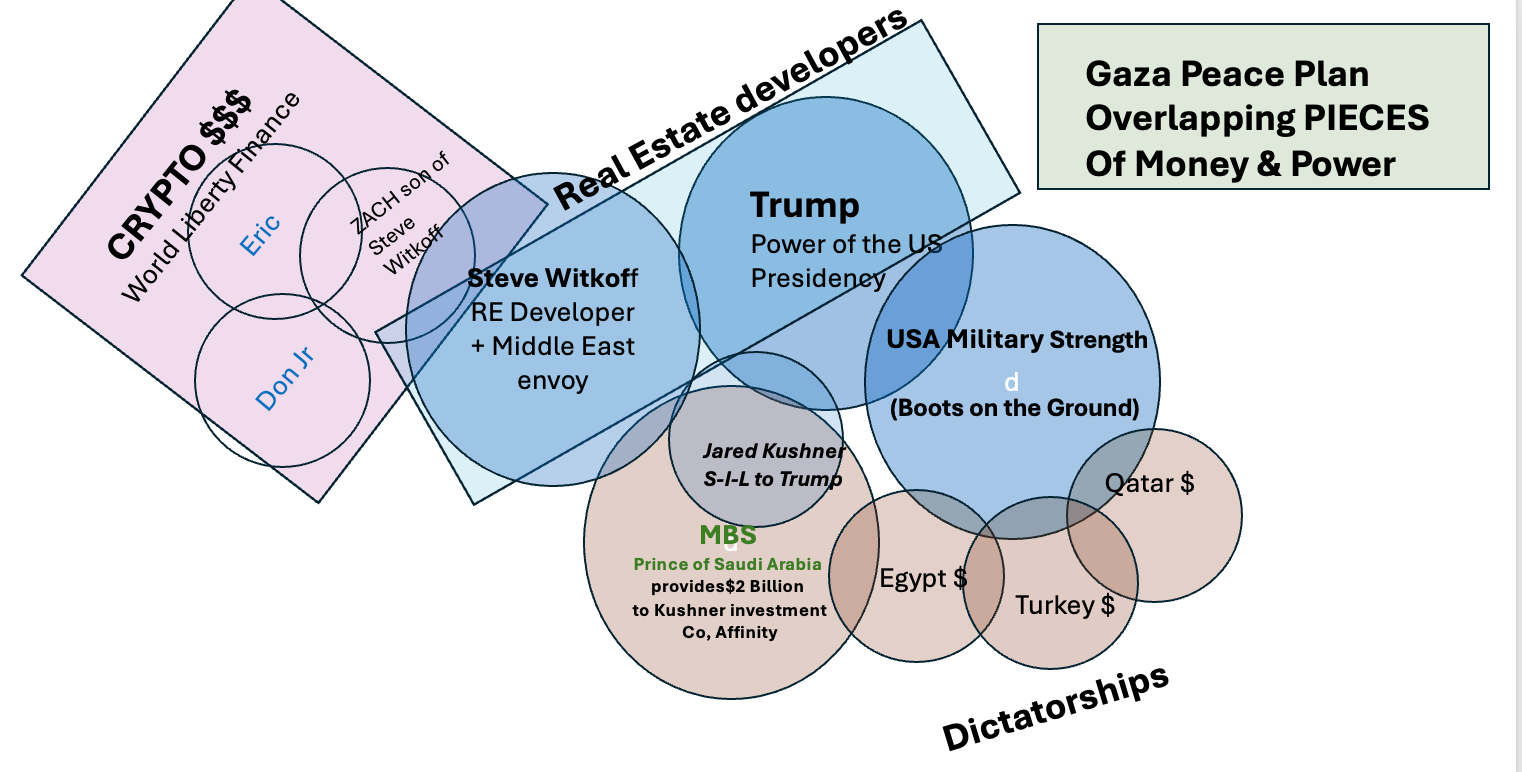
The Key Players
Steve Witkoff - Special Envoy to the Middle East.
Background
• • Founded Witkoff Group in 1997, focusing on development, repositioning, acquisitions of high-profile properties (commercial, residential, mixed use) in major U.S. cities. The Witkoff Group has been active in over 70 properties.
Estimated Personal wealth of over $2 Billion
• • Over the years, Witkoff and Trump developed a friendship, including golfing together and participating in overlapping business and real estate circles.
• Critics have flagged potential conflicts of interest: Witkoff maintains significant real estate and investment interests while being in the diplomatic role. For example, media reports claim his private investment firm (or related ventures) received major funding from foreign sovereign or state-affiliated investors (e.g. Abu Dhabi’s sovereign wealth fund) while he was serving as envoy, raising questions about whether his diplomatic role and business interests intersect. The Guardian
• Because of the personal relationship, Witkoff is likely to have near-direct access to Trump, allowing him to act as a messenger, gatekeeper, or policy influencer in a way that career diplomats might not.
Zach Witkoff- The son of Steve Witkoff
Zach Witkoff built a global crypto empire in months (original founder of World Liberty Finance, now 60% owned by the Trump Family)
WLF has developed the stablecoin USD1, becoming the fifth-largest cryptocurrency in a matter of months and designed to replace the US Dollar (see entry under Don. Jr and Eric)
Note: Zach Witkoff’s business transactions with Abu Dhabi state-backed MGX Fund Management Limited attracted scrutiny as a result of his father’s role as 1st United States Special Envoy to the Middle East.
Saudi Arabia’s Prince Mohammed bin Salman’s (MBS)
invested $2 billion in Jared Kushner’s firm, Affinity Partners, which has raised significant controversy and ethical concerns. The investment was made despite objections from the Saudi sovereign wealth fund’s own advisory panel, who questioned Kushner’s lack of experience in private equity.
The core reasons behind the investment, according to critics, relate to Kushner’s close relationship with MBS during his time in the Trump administration. This relationship provided Saudi Arabia with a valuable link to the White House, and the investment is seen by many as a reward for past actions and an effort to cultivate future influence.
The investment has continued to draw scrutiny and has raised concerns about the ethical gray areas surrounding former government officials using relationships to secure lucrative business deals. It also highlights broader issues regarding the influence of foreign governments through investments in U.S. political figures. .
Jared Kushner, Donald Trump’s son-in-law
Affinity Partners is an American investment firm based in Miami, Florida. It was formed in 2021 by Jared Kushner, who also served as a senior advisor during Trump’s first presidency. The firm has a focus on investing in American and Israeli companies.
The largest investor by some margin is the Saudi government’s sovereign wealth fund, the Public Investment Fund, which has allocated $2 billion to the firm. Officials who headed the Public Investment Fund objected to investing in Kushner’s firm, but Saudi ruler Mohammed bin Salman overruled those officials. The firm is fully owned by Jared Kushner. By 2024, the firm had returned no profits to its investors.
Don, Jr. and Eric Trump, sons of President Trump
deeply involved with Cryptocurrency with their ownership position in World Liberty Finance (WLF, a”DeFi”)
Trump’s sons are heavily involved in crypto which I covered in a previous substack. They are actively involved in gaining power via partnerships and strategic moves fortified by their father’s ability to use the power of the presidency to change the rules of and to influence the crypto marketplace
· Note: WLF’s stablecoin, the “USD1” is NOW redeemable 1:1 for U.S. dollars. USD1 is backed by dollars and U.S. Government Money Market Funds., Built for businesses & developers USD1 is broadly available to institutions, individuals, and DeFi participants with 26 “Providers”.
Feb 6, 2025 at ONDO conference Donald Trump Jr. said that crypto is the “future of American hegemony.”
Note: Hegemony is when one power sets the rules and others follow — not necessarily by force, but because that dominant power controls the most money, military strength, ideas, or cultural
Qatar
Reminder: Qatar is the country that “gifted” Trump with a $300 million luxury jet.
Qatar was also key to negotiations with Hamas given Qatar had provided support for Hamas:
By serving as the primary diplomatic channel between Israel and Hamas, Qatar has made itself an “indispensable” partner to the U.S. and other Western nations.
Leveraging ties with Hamas. For years, Qatar has hosted Hamas’s political office and provided financial support to Gaza. While criticized for these connections, Qatar has used this relationship to position itself as a necessary intermediary in negotiations. This gave Qatar unique access to Hamas during the hostage crisis, an asset that was leveraged to bring about the current ceasefire.
Supporting Palestinian reconciliation. Qatar’s long-standing pro-Palestinian policy aligns with its regional goals. It has historically sought to foster reconciliation between the Palestinian factions of Fatah and Hamas. By backing the current peace framework, Qatar aims to play a leading role in determining Gaza’s political future.
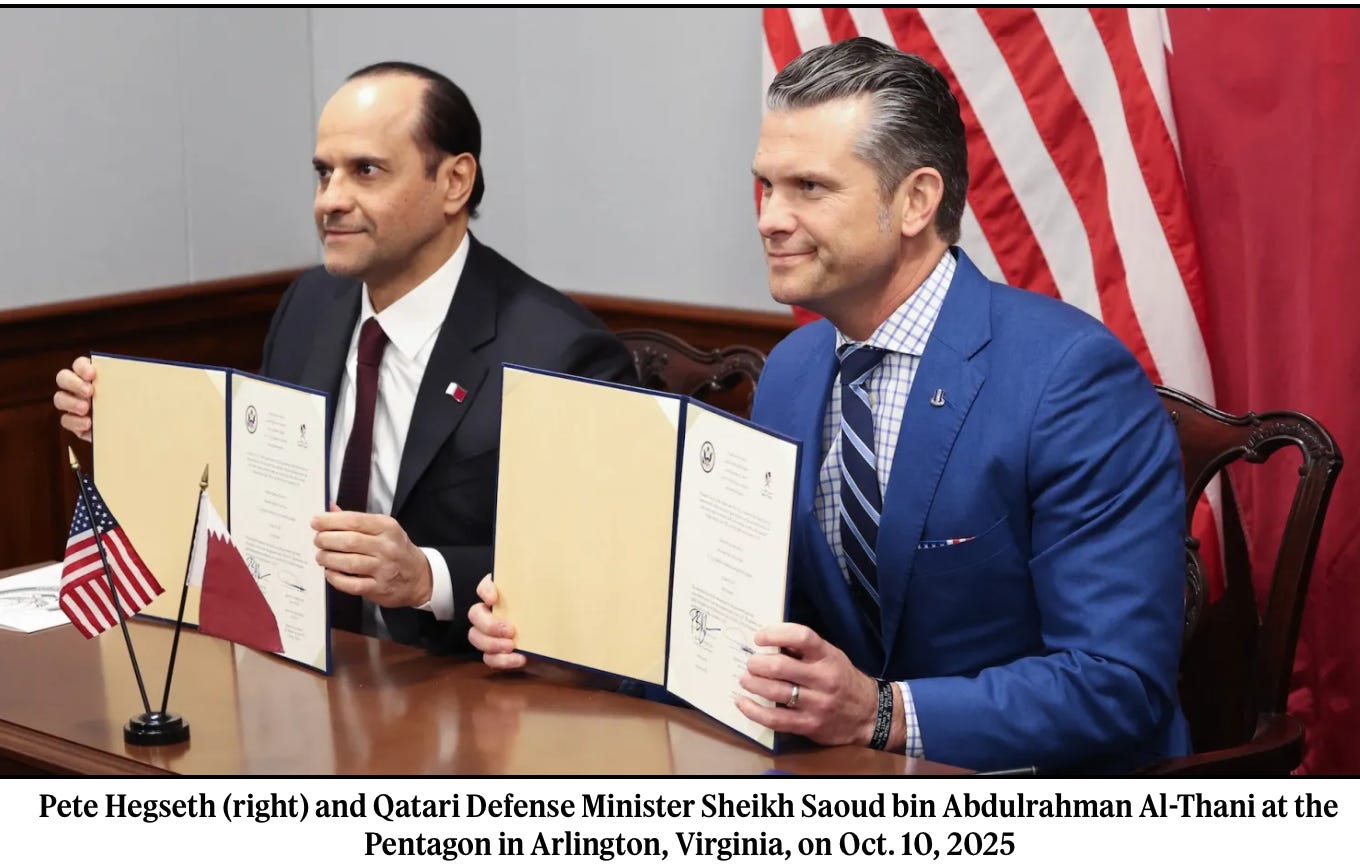
Tit for Tat?
3 Days before the Peace Declaration was signed:
“Today, we’re announcing a letter of acceptance in building a Qatari Emiri Air Force facility at the Mountain Home Air Force Base in Idaho,” Hegseth said Friday while standing beside Qatari Minister of Defense Sheikh Saoud bin Abdulrahman Al-Thani.[1]
According to the plan that Defense Secretary Pete Hegseth announced Friday, Idaho’s Mountain Home Airbase will soon house a site for Qatar‘s Emiri Air Force pilots to train on F-15 jets.
Qatar would sign the recently announced Gaza peace plan because mediation and regional stability are central to its foreign policy, and the plan strengthens its reputation and influence as a critical diplomatic partner
. Having co-brokered the deal alongside Egypt and the U.S., Qatar’s signature formalizes a role it has been playing for years and reinforces its strategic objectives.
Key factors motivating Qatar’s involvement and signature include:
Elevating its international standing. As a small Gulf state, Qatar uses “soft diplomacy” to increase its global influence and secure its position among more powerful neighbors. By serving as the primary diplomatic channel between Israel and Hamas, Qatar has made itself an “indispensable” partner to the U.S. and other Western nations.
Leveraging ties with Hamas. For years, Qatar has hosted Hamas’s political office and provided financial support to Gaza. While criticized for these connections, Qatar has used this relationship to position itself as a necessary intermediary in negotiations. This gave Qatar unique access to Hamas during the hostage crisis, an asset that was leveraged to bring about the current ceasefire.
Supporting Palestinian reconciliation. Qatar’s long-standing pro-Palestinian policy aligns with its regional goals. It has historically sought to foster reconciliation between the Palestinian factions of Fatah and Hamas. By backing the current peace framework, Qatar aims to play a leading role in determining Gaza’s political future.
Ensuring regional stability. Qatar’s economic interests, particularly its liquefied natural gas exports, depend on peace and security in the Middle East. By actively engaging in conflict resolution, Doha protects its trade routes and fosters a favorable environment for its long-term economic diversification goals.
Responding to international pressure. Qatar has mediated negotiations under significant pressure from the U.S. and other international partners. Signing the plan follows consistent requests from these nations for Qatar to continue using its influence to secure a deal.
This multi-pronged approach allows Qatar to balance competing interests—maintaining ties with Hamas, protecting its U.S. partnership, and pursuing its own regional ambitions—all of which are advanced by signing the peace plan.
Summary: Who benefits from Peace in the Middle East:
Country and What peace would bring
Egypt
Jobs, secure borders, revived tourism, regional leadership.
Turkey
Export & construction boom, restored influence, stable energy trade.
Saudi Arabia
Vision 2030 stability, global investment confidence, diplomatic prestige.
Jordan
Economic breathing room, social stability, reduced refugee pressure.
Lebanon
Avoids new warfront, possible reconstruction contracts.
Region overall
Lower oil volatility, better trade routes, cooperative megaprojects.
Who are the Palestinians
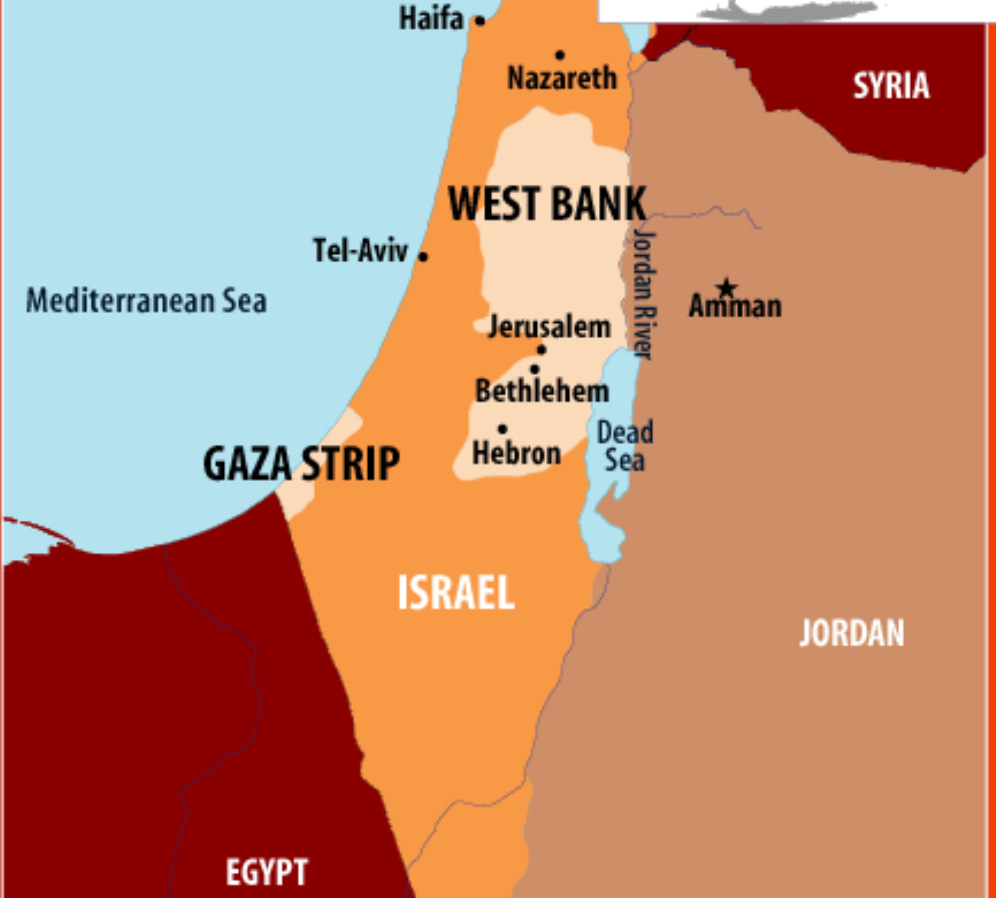
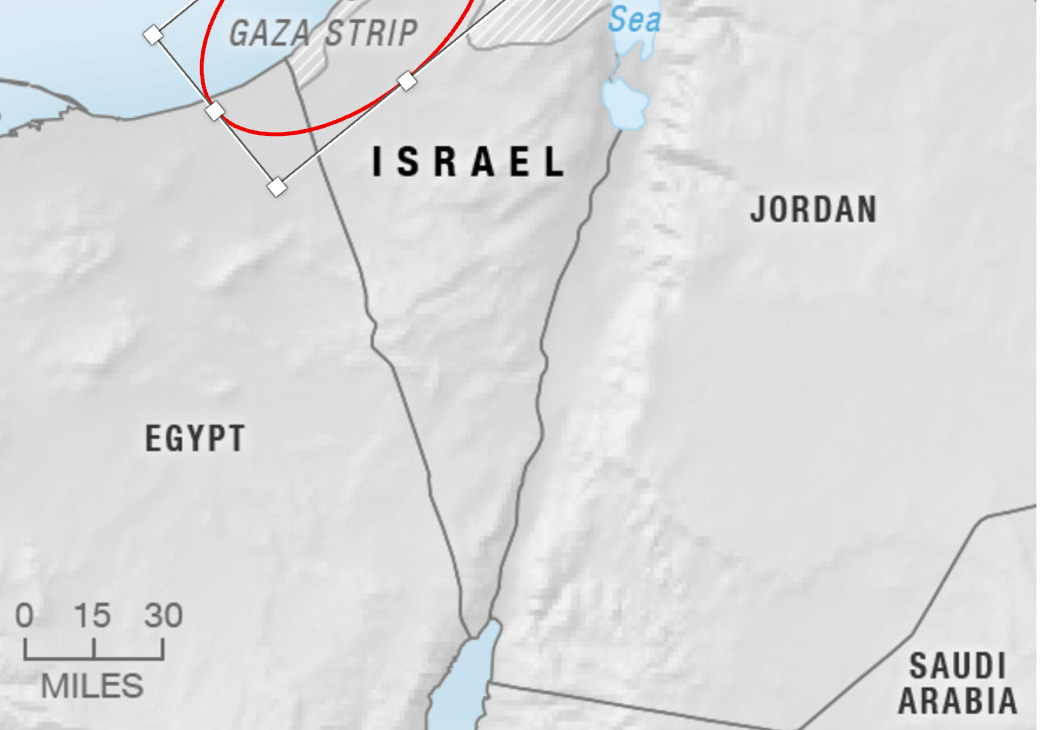
Palestinians are the Arab people whose ancestral homeland is Palestine — a region historically located between the Mediterranean Sea and the Jordan River.
They share a common language (Arabic), culture, and heritage, and their identity developed around a distinct sense of belonging to that land, which includes present-day Israel, the West Bank, and the Gaza Strip.
For centuries under the Ottoman Empire (1517–1917), the people living there were mostly Arabic-speaking Muslims and Christians, along with Jewish communities. More recent changes:
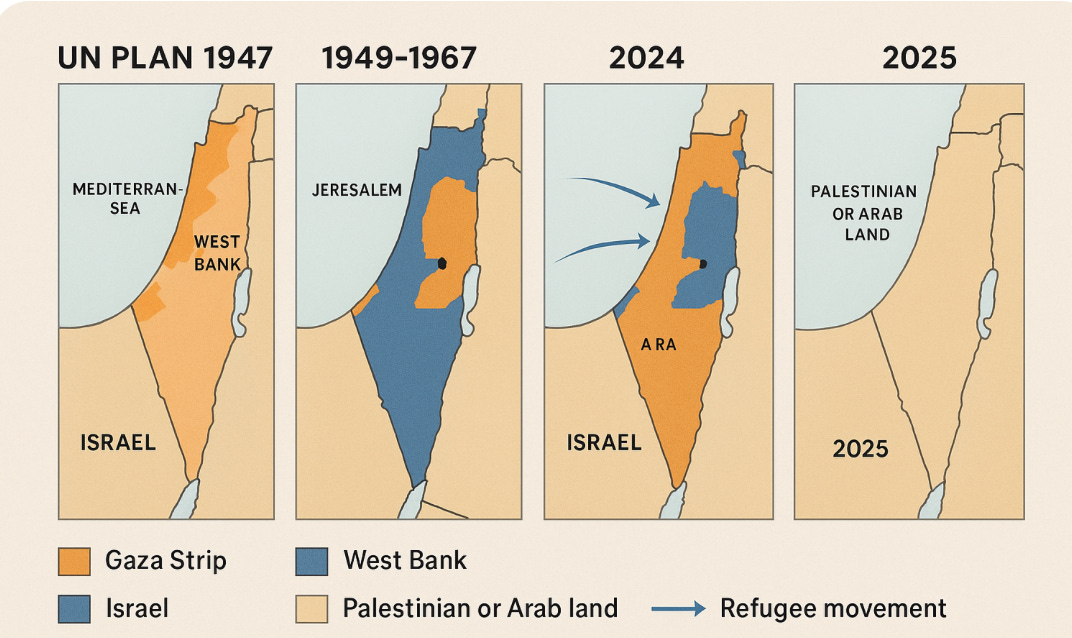
Secrecy abounds around the big question:
How to get the people from Gaza to leave and where would they resettle ? The 20 point plan specifies that they will not be forced out, but that leaves open the idea of “buying” them out.
Where Palestinians Live Today
Region and Description
West Bank
Territory occupied by Israel since 1967. About 3 million Palestinians live there, under a mix of Israeli and Palestinian Authority control.
Gaza Strip
Small coastal enclave, home to ~2 million Palestinians. Governed by Hamas since 2007, heavily blockaded by Israel and Egypt.
East Jerusalem
Claimed by Palestinians as the capital of a future state. Israel annexed it, though this isn’t recognized internationally.
Inside Israel
Around 1.9 million Palestinian citizens of Israel (about 20% of Israel’s population) — often called “Arab Israelis.”
Diaspora / Refugees
Millions live abroad — especially in Jordan (the largest population), Lebanon, Syria, and in the wider diaspora (U.S., Chile, Europe, Gulf).
Altogether, there are about 14 million Palestinians worldwide, half living inside historic Palestine and half abroad.
Palestinians see themselves as a distinct people with:
• A shared language, culture, cuisine, music, and folklore.
• A deep connection to the land — farms, villages, olive groves, and holy sites.
• A long struggle for self-determination and statehood.
Their political goal (since the mid-20th century) has been the creation of an independent Palestinian.
Note: The 2000 Palestinians released by Israel under the Peace Pact were immediately deported to Egypt
Political Representation of Palestinians
Body and Role
Palestine Liberation Organization (PLO)
Founded 1964; recognized internationally as the representative of the Palestinian people.
Palestinian Authority (PA)
Semi-autonomous administration created by the 1993 Oslo Accords, governing parts of the West Bank.
Hamas
Islamist political-military movement that controls the Gaza Strip since 2007; designated a terrorist group by the U.S., EU, and others.
Note: aided financially by Qatar
Other factions
Islamic Jihad, Popular Front for the Liberation of Palestine (PFLP), Fatah (dominant in the PA).
Why It Matters
Understanding who the Palestinians are is essential to understanding:
· Why the conflict persists: it’s about land, identity, and rights, not only politics.
· Why displacement and “ownership” of Gaza’s coastline are emotionally charged — because for Palestinians, their land is their nation, not just territory.
A stable, non-war environment in Gaza (and Palestine–Israel generally) isn’t just about those two peoples; it’s about how the entire region’s political and economic future hinges on stability.
Subtext: you can’t build a luxury resort in a non-stable environment. The promise of not only obtaining but KEEPING a stable, peaceful environment is critical to the success of a luxury resort.
How the rest of the Middle East benefits from a stable, peaceful environment.
1. Egypt: Economic Lifeline and Border Security
🔹 Economic and Trade Benefits
· Peaceful Gaza = stable Sinai. Egypt’s Sinai Peninsula has been a security hotspot (militant groups, smuggling). A peaceful Gaza would drastically reduce cross-border attacks and illicit trade, enabling Sinai tourism and development.
· Revived Suez and Port Trade: With regional stability, Egypt could expand its Suez Canal economic zone and its Mediterranean ports (Port Said, El Arish), becoming a hub for Gaza reconstruction logistics.
· Reconstruction contracts: Egyptian companies would be primary suppliers of cement, steel, and workers to rebuild Gaza, injecting billions into Egypt’s struggling economy.
🔹 Political and Diplomatic Leverage
· Egypt would regain its role as the primary regional mediator — boosting Cairo’s diplomatic stature with the U.S., EU, and Gulf partners.
· Peace would also reduce domestic political pressure from public outrage over the Gaza war and from potential refugee influxes.
In short: Stability gives Egypt money, calm borders, and diplomatic prestige.
2. Turkey: Economic Expansion and Strategic Influence
🔹 Economic Payoff
· Turkey’s construction firms (among the world’s largest) could secure major contracts in rebuilding Gaza — ports, housing, infrastructure, energy grids.
· Trade routes through the Eastern Mediterranean could reopen or expand, allowing Turkish exports to reach the Arab world more easily.
· Stable conditions reduce oil price volatility, aiding Turkey’s inflation-plagued economy.
🔹 Political Soft Power
· Turkey under Erdoğan has positioned itself as a protector of Palestinian rights.
o In a post-war environment, Ankara could claim moral victory while working pragmatically with Israel, the PA, and Arab states.
o It could reassert influence in the Organization of Islamic Cooperation (OIC) and among Arab publics.
· Stability would make Turkey a bridge between the West (NATO, EU) and the Muslim world — enhancing its leverage in both directions.
In short: Peace gives Turkey economic opportunities and geopolitical credibility.
Saudi Arabia and Gulf States: Vision 2030 and Regional Investment
🔹 Economic Diversification
· MBS’s Vision 2030 depends on stability — tourism, tech zones, and NEOM (the $500B megacity) can only thrive if the region feels safe to investors.
· War scares investors; peace brings foreign direct investment (FDI) and tourism.
· A stable Gaza allows Riyadh to normalize with Israel without enraging Arab publics — unlocking U.S. defense guarantees and more Western partnerships.
🔹 Strategic Payoff
· Stability cements Saudi Arabia as a regional leader in peacebuilding, rather than just oil production.
· The kingdom can channel its wealth into reconstruction diplomacy, winning global prestige.
4. Jordan: Refugee Relief and Political Calm
· Jordan hosts millions of Palestinians; renewed war fuels instability and refugee fears.
· Peace would allow Amman to focus on its water crisis, economy, and tourism, rather than managing the political fallout from Gaza.
· Jordan could expand cross-border trade (especially via the Allenby Bridge and Aqaba port), helping its fragile economy.
5. Lebanon: Avoiding Another Front
· Lebanon’s Hezbollah is a constant flashpoint.
· A durable Gaza peace could reduce pressure for Hezbollah-Israel escalation, stabilizing Lebanon’s already collapsing economy.
· Reconstruction aid might ripple northward — creating jobs for Lebanese engineers and logistics workers.
Broader Regional and Global Benefits
Domain
Stable (non-war) impact
Energy markets
Predictable oil & gas prices; less war-risk premium. Gulf and Eastern Mediterranean pipelines could expand safely.
Trade & Shipping
Suez Canal, Red Sea, and Eastern Med routes remain secure — crucial for global supply chains.
Tourism
Peace means revived travel to Egypt, Jordan, Turkey, and Israel — all tourism-dependent economies.
Migration & Refugees
Fewer displacement waves into Europe and neighboring states. Humanitarian pressure eases.
Climate & Infrastructure
Reconstruction allows regional cooperation on desalination, solar power, and water projects across borders.
All the players agreed to “peace” because they all got a piece of the action. Stability in the Middle East is good for their economy. Religion and heritage are important yet evidentially pale in the face of economic opportunity
A PIECE of the action includes benefiting from the take over the Gaza strip and converting it into a militarily enforced stable, peaceful “Neutral zone” as a money making tourist attraction.
He wasn’t kidding: A beachside resort is in the future of Gaza as Trump stated back in February, 2025:
What does Hamas get?
It’s not clear they will reap the economic benefits that Middle East countries will likely see. It may increase they leverage with other Palestinians as they secured the release of 2000 Palestinian prisoners
Why would Trump volunteer peacekeeping assistance?
This would obviously require boots on the ground.
How timely that Trump’s growing (“non military agent of peacekeeping”) ICE force would be available.
From Trump’s 20 point peace plan:
14. A guarantee will be provided by regional partners to ensure that Hamas, and the factions, comply with their obligations and that New Gaza poses no threat to its neighbours or its people.
15. The United States will work with Arab and international partners to develop a temporary International Stabilisation Force (ISF) to immediately deploy in Gaza. The ISF will train and provide support to vetted Palestinian police forces in Gaza, and will consult with Jordan and Egypt who have extensive experience in this field. This force will be the long-term internal security solution. The ISF will work with Israel and Egypt to help secure border areas, along with newly trained Palestinian police forces. It is critical to prevent munitions from entering Gaza and to facilitate the rapid and secure flow of goods to rebuild and revitalize Gaza. A deconfliction mechanism will be agreed upon by the parties.
Since the Gaza strip is about 2/3’s the size of Chicago but with a much denser (pre war) population, it ties into Trump using the US military to constrain violence in US cities as a kind of “training ground” for our soldiers (his words!)
Trump: accepting praise for “Ending the war, said “and start of a soon be truly magnificent region”mm(clear the rubble and people and make way for a beachfront golf course.)
[1] https://www.rollingstone.com/politics/politics-news/trump-qatar-military-facility-us-maga-1235445791/
Great article.